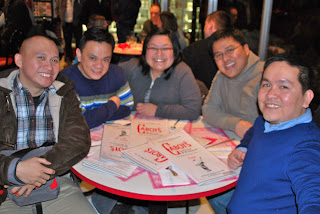
Saturday, February 19, 2011

Audition Day

Saturday, February 12, was the day of my Berklee audition.

The night before, I was confident that I would have a good night’s sleep. I was exhausted from a day of walking around Boston, and practicing for nearly three hours with the Pinoy choir. Besides, with the two hours of piano practice Jett had gotten me at Berklee that afternoon, I thought I had overcome whatever audition jitters remained. After all, GP had advised me months before: “Just be cool and have fun. The panel likes meeting applicants who just enjoy making music.”

But then, after sleeping for just two hours, I woke up, wide-eyed, unable to fall asleep for the next two hours as I watched an epic flashback flicker in my mind: a montage of every piano, keyboard, and organ I had ever played. The miniature, Schroeder-esque baby grand piano I had destroyed when I was three by repeatedly banging out my rendition of Beethoven’s 5th; the yellow-keyed piano owned by the little old lady who gave me piano lessons as a kid, down the street from Lola’s house; those Electones during lessons at Yamaha in kindergarten and grade school; the monophonic battery-operated keyboard Tita Josie sent from New York one Christmas; the progressively more sophisticated keyboards, and finally the second-hand piano, that my parents bought me as they saw year after year how was serious I was about playing; that hideous, musty organ in the Kingsville chapel during my brief stint with the village choir; that jangly old piano in the high school chapel that I had played for morning Masses and for Days with the Lord; the keyboard in the college chapel, and the keyboard ACMG got the funds to buy in fourth year; every piano and Clavinova and Electone I had played at Hangad weddings and concerts and recordings, in Manila, around the Philippines, and in the US; Hangad’s trusty Yamaha keyboard; and the electric grand piano in my condo, that I had bought for myself two years ago.

I finally fell asleep at 6 AM—which gave me only a 30-minute nap before I had to get up, get to Berklee, have a quick breakfast in the area, and be at the audition venue by 8 AM.

Thank God for coffee—and to Jett, for recommending that amazing Spanish Latte at the Berklee students’ de facto hangout, Pavement Cafe. Kyle and I had breakfast there after he took Lance to work earlier that morning; after which I walked the short distance to the audition venue, Berklee’s Genko Uchida building down the street.

Student volunteers took my name and led to the recital hall on the ground floor, where several kids, around high school age, were seated with their parents. Some kids were happily jamming together on their guitars; some were fidgeting nervously, with their violin and saxophone cases on the floor beside them. Some were in torn jeans, sneakers, and sweatshirts; some were in suits and ties. Ten chairs, numbered one to ten, were set up along the far side of the room. On a large screen at the front of the room were the numbers one to ten, and beside each number the auditionees’ names would flash to call them to the chairs. From watching the names on the screen, I realized that while half of the kids looked like white Americans, there were actually several Europeans among them: Spanish, Italian, French, Eastern European. (The other half of the kids was a mix of African-Americans, Hispanics, and Asians.) Along with auditionees’ names, their principal instruments would flash too—and I found it interesting that for every batch of 10 names, there were only one to two pianists. I had thought there would be more of us. The majority, four to five per batch of 10, were guitarists; one to two were electric bassists; one to two were vocalists; and the rest were violinists, flautists, saxophonists, drummers, acoustic bassists, and more.

It wasn’t long before my name flashed on the screen to call me to chair number four; and it wasn’t long again before a student volunteer, a freshman guitarist named Oliver, led me into an elevator and brought me to an upper floor. An auditionee ahead of me was still using the room, so Oliver used the time to remind me of that I would have 15 minutes in this room to warm up and study a piece of music that would serve as a sight-reading test.

The warm-up room was a classroom, but instead of desks there were rows of electric pianos, totaling about 12, facing the front of the room. Resting on one of the pianos was a binder of music sheets, which Oliver opened to the “piano” tab. To my surprise, there were eight pieces of music that I had to study. Sure, each was only around eight bars, but I also had to do one run of my five-minute prepared piece.

I dove right into the warm-up. I started with studying each of the sight-reading pieces. Most of them had both the treble and bass clefs notated—there was an easy dramatic film score-ish piece, an easy pop piece, a jazzy piece where I had to struggle not to improvise—and there were also lead sheets that just gave chords and rhythm. Luckily, I got through all of them, and had time to do a double-tempo run of my prepared piece.

After my fifteen minutes were up, I was led to another floor to wait for my audition. It was embarrassing that I slightly overestimated my waiting time, and found that my panel had been waiting when I returned from the restroom. Thankfully, both my panelists—they introduced themselves as Danny and Susanna, and I presume they were from the piano department (Jett said later that Susanna is an incredibly talented pianist)—were still good-natured as I entered the classroom that served as an audition room, and was directed me to sit at the Yamaha upright at the front of the room. They asked my name and where I was from (they seemed impressed that I had flown halfway across the world); asked if I had had any piano education; asked what I would be playing; and finally, asked me to play.

“Can I take a video of myself while playing?” I asked before starting. “Maybe it wouldn’t be a very good idea,” Susanna had said; and so all I have is a memory. I remember taking a deep breath, rolling my shoulders back, stretching my arms outwards to loosen them up one last time, putting my fingers on the keys and flexing them there and—taking one more deep, slow breath—starting to play. I remember that my suite from Cinema Paradiso, which I had spent the last weeks arranging and adjusting and polishing and perfecting, had never sounded better. I remember being so happy during those five minutes—so in love with what I was doing, then and there, as I moved from the nostalgic main theme, to the playful childhood theme, to the sweeping love theme—that I almost started to cry. I remember that I had remembered not to put on my dead face, as Anama had so often chided me, and instead put as much intensity and emotion on my face as I could. And I remember that, for maybe only the third time since I had started practicing the piece, I got through it without any mistakes.

I heaved a sigh of relief as I played the final chord. They didn’t applaud or say “good”; I didn’t expect them to, after all it was an audition. They just said “okay” and wrote down their notes.

We moved to the next part of the audition, which was the music tests. There were several parts. First, Susanna asked if I could do blues improvisation; “Kinda,” I said, and she sat beside me on the piano bench, played the notes of the blues scale in C (which I had familiarized myself with some weeks back, with Kenneth’s help), and started on a basic blues progression, while I improvised at the right end of the piano keyboard. My own assessment of my improv was that it was correct, but uninspired.

Susanna moved on to having me form chords. “Can you play a dominant 7th chord?” Check, with a C7. “Can you do that in G?” Check. G7. “How about a D minor 7th?” Check. “How about an A flat minor 7th?” Whoops. I played an Abm+M7, heard immediately that it sounded wrong, and said , “Oops, that’s not right.” Susanna said, “Okay, how would you fix that?” I flattened the G. “Good,” she says. (I figure now that even if I got it wrong, at least I knew it was wrong, so that should get me at least partial points. Haha.)

Then came progressions (“Can you do a II-V-I?” “Okay, can you do it without moving all the notes?”—I think I did okay, with Dm to G chord without shifting the D, and then from G to C chord without shifting the G); chord-naming tests (Major? Minor? Augmented? Diminished?—I had two mistakes, argh); rhythm-matching tests (Susanna counted in the time, played rhythm sequences of two to four bars, and I repeated; I got two right the first time, I had to repeat two); and tone-matching tests (Susanna played sequences of notes while I looked away, which I would then imitate; perfect score for me in this part, hooray).

Lastly Susanna asked if I could sight-read. I said yes. She laid a copy of the audition binder on the piano’s music rack and asked me to play number two, the easy pop piece. I got the rhythm wrong the first time, since I had practiced it much faster in the warm-up than her count-in now; the second time, it came out perfect.

“We’re done. Thank you,” they both said after that. I replied, “Already? I’d love to do more.” And I meant it. I found myself hugely enjoying the tests—particularly, the fact that there were people who spoke and appreciated the same musical bwabwabwa that I did.

Next I was led upstairs to the admissions office, where I was interviewed by an Asian-American student admissions representative, a senior at the school. I honestly found the interview anticlimactic: what I had hoped to be 15 minutes packed with drama and sound bites about pushing the reset button on my very comfortable corporate life to follow my dreams and live out my passions turned out to be boring, even annoying, as my interviewer blandly ran down his checklist of questions—“Why do you want to study music at Berklee?” “What will you be able to contribute to the Berklee community?” “What do you plan to do afterwards?” “In three words, how would you describe your music?”—and just stared into his MacBook, typing non-stop, as I spoke. At one point I stopped and said, “Uhm, should I wait for you to finish typing?” He looked up and answered, “No, just keep talking. I’m trying to get this all down.” The writer and HR person in me was aching to give him a lesson in conducting interviews. No probing of any answer I gave, no reaction to anything specific; only a patronizing, “That’s great! Amazing!” after every answer I gave. No wonder the interview was only 15 minutes long. Or looking at it another way—maybe he interviewed that way precisely because each applicant was given only 15 minutes. Oh well.

After that, my audition and interview were done. My interviewer told me I would get my admission and scholarship results via e-mail on March 31.

I decided to stay on at the school for some activities prepared by admissions team. I headed back down to the hall, where many more students and parents were now waiting. The anxiety and energy had built up considerably, with parents asking the student volunteers in the hall about the audition process, the interview process, housing, and scholarships. A few minutes after I arrived at the hall, an Eddie Murphy-ish student ambassador named Will Wells, a graduating double-major in Film Scoring and Music Production & Engineering (and, I learned from Jett later, one of the school’s star students), gave a talk about his experience at Berklee. He had gone to Finland to perform on the school’s behalf; he had worked in a studio with John Mayer, Wyclef Jean and Sara Bareilles (note to self: look up Wyclef Jean and Sara Bareilles), and he had a job waiting for him (in Hollywood, I think) after graduation.

Joining Will on stage at the end of his talk for Q&A (most parents had questions about financing, scholarships, acceptance rate, and housing) was Todd, the school’s director for admissions. After the Q&A I approached Todd to air two concerns that had built up inside me during Will’s talk: first, that I had been unable to share anything about my songwriting (I had a complete set of Hangad CDs and songbooks, and a MacBook with videos of performances and film scores in my bag); and second, that the interview was short and not very substantial, and that there was much more meat in the 11-page single-spaced set of essays (the Berklee questionnaire had 17 essay questions with no word limit) that I had sent with my application last December.

Todd was very reassuring on both my concerns. First, he said that the audition really was for performance, not for writing, and that if I had applied for the Berklee Songwriting and Composition Scholarship (which I had last January, with a CD and scores of 15 of my songs), then for sure my work would be evaluated by the writing department. And second (in retrospect, it was rather stupid for me to ask, even humorously, “Do you guys actually read the applications?”) he said that the interview is used to validate what’s written in my application, and that the Board of Admissions does read the applications. (GP, who had worked in the admissions office as a student, later validated this.) Whew, I was able to breathe much easier after this talk with Todd.

It was noontime by then, and my last activity for the day was a tour of the campus. While waiting in the lobby for it to start, someone (either a faculty member or an administrator) asked the crowd, “So who’s flown the farthest to audition?” “Chicago,” called out one parent; “Florida,” said another. I, standing at the back of the crowd, raised my hand and said, “Manila.” Everyone turned toward me, beaming with what was either fascination or condescension, and said: “You win.”

The tour was quick: a student representative took us to a selection of the 12 buildings scattered around one of Boston’s busier intersections, that comprise the Berklee campus. Highlights were the performance center, the music library, the practice rooms, and the studios.

We were done around 1:30 PM. Before heading to the nearby mall to have lunch and meet up with Kyle, I stopped again at the Berklee bookshop. The day before, I had been struggling with the decision whether or not to buy a Berklee College of Music collegiate sweatshirt, which I had seen online and drooled over weeks before. Apart from there being no fitting room, or even a mirror at the store; and the Philippines really not being a sweatshirt kind of country; I also realized that, as excited as I had been for the audition and interview these past weeks—climaxing in my previous night’s sleeplessness—now the real excitement began. I had put my heart and soul into my application and audition—the eleven pages of essays, my trips to Ateneo for my grades, the portfolio for the songwriting scholarship, my audition piece, flying halfway around the world to be im Boston, and pouring my whole self into the audition itself—and now, all I could do was wait, and hope.

I walked out of the store, deciding I would get that sweatshirt in the Fall. For now, my fingers are crossed for March 31.

Tuesday, February 15, 2011

Boston Retrospective

It’s 6:30 AM, and I’m sitting by the window of the food court of Logan International Airport, watching the sun rise over the tarmac, casting golden sunlight and long shadows on the first few flights of the day.

My flight to New York isn’t until 10:35 AM, but Kyle missed his flight to Denver last night and took the first flight out this morning instead; and I decided to already come along so Lance wouldn’t have to make two trips to the airport. Which was just as well, since I wouldn’t have wanted to reel at the US$25 baggage charge and still fumble to move 10 lbs from my baggage to my carry-on luggage at a busier hour of the day. This is the last time I’m taking American Airlines (and probably the last time I’m using that travel agent in Manila as well).

AA angst aside, I had a great breakfast—praise God for club burritos and banana smoothies!—and anyway, why let a few sour minutes spoil what’s been an amazing five days in Boston?

A not-so-brief recap:

Lance picked me up from Logan on Wednesday night, after I had spent over 24 hours in transit. The wait outside the airport was my first ever encounter with subzero weather—piles of ice and gusts of wind all around. I tried to will my body to deal with it, but finally succumbed to the urge to rifle through my bag for my gloves before my fingers turned to icicles on the curb. Lance arrived soon enough, and his apartment in Cambridge is just 10 minutes from the airport. Kyle, who had flown in from Denver days before, had a delicious spaghetti dinner prepared at home. It had been years since I last sat down and talked with Lance and Kyle—and we Skyped with GP and Mikee in New Jersey inbetween—so we slept past 1 AM.

The next day, Thursday, Lance drove us through streets lined with heaps of crushed ice, blackening in some parts, to Harvard Square, where we had breakfast at International House of Pancakes. Mia Cruz had called Kyle shortly before we left the house, and instead of spending the day working on her dissertation, she joined us at IHOP (which led me to ask later, “Ganyan ba buhay mo rito? Pa-shola-shola na lang?”). We walked around Harvard and down to the frozen Charles river, then drove to Boston Common, the city’s version of Central Park (a nicer version, I would dare say, because it’s built on upward-sloping ground, and the size is much more manageable). We walked up to the Massachusetts State House, then down to Newbury Street, where we went inside Trinity Church and had coffee at the Prudential. That evening, Lance and I walked to Marshall’s and Target near their place; then the three of us sat down to a steak dinner Kyle had prepared.

With old friends Lance and Kyle near Harvard Square. (Or is this still part of Harvard Square?)

Friday was to be my first encounter with Berklee College of Music, and my first ride on Boston’s subway, the T. What should have been a pleasant ride and a short walk to the school turned out to be a character-building experience. For one, I learned that the T isn’t your typical high-speed light rail that seats a thousand, runs smoothly, and pulls into a station before you know it. Instead, each train on the T consists of two narrow, 20-seater cars (more like a tram than a train, if you think about it). These trains whine and wheeze, thud and tumble through twisting tunnels under Boston, braking every so often when there is traffic on the tracks ahead. I got motion sickness on my first ride. More than that, on my first ride, I also got off two stops earlier than I had planned, when an announcement came that there was a train stalled at the next station and we would be stuck indefinitely. I figured it was pretty much the same route that Lance, Kyle, Mia and I had walked yesterday, maybe even shorter, so what the heck. What I hadn’t figured was that the walk would be much more tiring without company, with a heavier bag, and with winter winds drying the sweat on my neck and your back.

But anyway, I made it. Jett met me at the lobby of Berklee’s main building at 150 Massachusetts Avenue, and we had lunch at the Berklee cafeteria: eat-all-you-can, with stations for salad, sandwiches, pizza and pasta, Mexican food, smoothies, bread, cereal, beverages, for only US$6.50. After lunch, Jett got me a much-needed two-hour slot at one of the school’s piano practice rooms—my audition was the next day, and I hadn’t sat in front of a piano for four days.

With Jett of the Ateneo Chamber Singers, and one of Hangad's sound engineers (ADMU AB Psy '05; Berklee College of Music, Music Production & Engineering '12).

When my two hours were up, I said goodbye to Jett, took the T to Government Center, and checked out Quincy Market, a shopping and dining complex in a historical square, with an interesting mix of restaurants, stalls, and shops (I enjoyed my first-ever visit to an Abercrombie & Fitch store, with its gorgeous salespeople, and that testosterone-packed fragrance throughout the store that makes you want to pounce on the aforementioned salespeople). Still stuffed from my eat-all-you-can lunch, I just got myself a cup of coffee and boarded the T home.

There was choir practice that evening at Lance and Kyle’s place, in preparation for the Filipino Mass on Sunday. I played the keyboard; Jett led practice; Mia and Joel were there; I met Tina, Rafa and Ene, Mabel, Ian, Ivan, Fanny and Jordan, and some others; and I was thrilled to see Fr Arnel.

Early Saturday morning, after Kyle took Lance to the hospital for Lance’s two-day shift, Kyle and I drove to the Berklee student hangout, Pavement, for a quick breakfast (thanks Jett for recommending that amazing Spanish latte!), before I went to my audition and interview (which I will blog about separately). The audition ended at around 1:30 PM, after which I went to the Pru for a [lousy] lunch at the food court. Kyle met me at the Pru and we drove to the city’s North End, where he had a huge pasta lunch; then we walked around the North End, to the Paul Revere Mall (“If it’s a mall, where are the shops,” Kyle had asked), down to the waterfront, across one of the many bridges, back to the Quincy Market and Faneuil Hall area where we spent some time at the New England Holocaust Memorial; then Mia called to remind us about dinner (with Fr Arnel saying “Don’t be late!” in the background).

Dinner was at Khao Sarn Thai restaurant; dessert after that was at Cabot’s ice cream house. The evening ended with us taking Fr Arnel back to his residence at Boston College—and me playfully stepping on a heap of snow that I mistakenly thought was tightly packed, and sinking thigh-deep into ice and screaming “Save me!”

With Fr Arnel, ACMG friend Mia, her husband Joel (who was also my "angel", or sponsor, when I tried out for Dulaang Sibol in second year high school--"you're a bad omen for my Berklee audition", I had told him jokingly), and Kyle.

I slept so soundly that night—from exhaustion, overeating, and post-audition relief—that I slept through my alarm the next morning, making us 30 minutes late for our call time for the Filipino Mass at Boston College. It was a pleasant Mass, with a friendly congregation in an intimate chapel. I bumped into Carlo, a grade four batchmate and co-reporter in the Ateneo Grade School paper, who now has a doctorate in physics (“I work with lasers,” he had said). Kyle and I grabbed a quick bite at the reception prepared by BC students after the Mass, then picked up Lance at the hospital and drove to the lovely port town of Rockport, around an hour from the city (I wouldn’t know exactly how long the drive was, I was asleep both ways). Rockport is a picture-perfect town, with narrow streets flanked by rows of colorful shops, and a romantic harborfront lined with charming houses—the kind you would imagine in movies. It was freezing and several shops were closed for the season, but I loved it nonetheless. Kyle said (and later showed me photos) that it’s even better in spring and summer.

Rockport.

Dinner that night was at Cheesecake Factory at the mall near Lance and Kyle’s place (nothing at all like Manila’s Cheesecake Etc., as I had initially assumed).

The next day was my last full day in Boston. It was also Valentine’s Day, so I told Lance and Kyle I would go off on my own and let them have “quality time.” I took the T back to Boston Common and went crazy with my camera on Beacon Hill, the old, posh residential neighborhood adjoining Boston Common; then had lunch at Finagle A Bagel and walked around a bit downtown before taking the T home mid-afternoon. As soon as I got home, the three of us went back out to rustic Charles Street (right at the base of Beacon Hill) where Lance and Kyle had a late lunch, and we walked around before I took the T back to Berklee, where Jett had arranged for a two-hour piano recording session for us in one of the school’s high-tech studios; and Lance took Kyle to the airport for his flight to Denver (which, I mentioned earlier, he missed). Jett and I had a burger dinner after the session—my first time to record with a live grand piano, rather than with MIDI—and then I headed home.

In frozen Boston Common. Can't wait to see this place in spring.

And now, here I am on my sixth and last morning in Boston, waiting at the airport for my plane to New York.

This must have been my most relaxed trip ever. I had two guidebooks (I was supposed to have just one, but I found a Fodor’s Boston 2009 for only Php150 at Powerbooks in Cebu a week before I left), but I didn’t have a fixed hour-by-hour itinerary the way I usually do. I had a vague list of places I wanted to go, and I though I didn’t get to go to a lot of them, I’m surprisingly okay with it.

Before the trip, I really didn’t know what to expect. Friends who have lived here (Lance and Kyle, Chad and Leanne, GP and Jett) rave about the place. Those who have visited give mixed reviews: Domi said it was alright, Elaine liked it, Chad S. said his mom loved it. Jia and Karlo said it was boring, with shops that close early and not much of a club scene. My guidebooks said it’s brimming with history and culture, but I’ve never cared much for US history; and that it was a compact, walkable city, but I figured it was just a marketing claim. For the most part, the impression I had was that it was a historical city and a college town. I hadn’t figured it would turn out to be much more.

Boston to me, today, is a charming, classy city, with clean streets and beautiful architecture; a chill city, where park benches and coffeeshops beckon you to just sit, and read, and write, and talk; an optimistic, energetic city, where the rich blue sky in the middle of winter reflects the percolation of thoughts and the creation of great, wonderful things; and yes, a compact and walkable city, where there’s something to see everywhere you look.

I love this city.

I love the open spaces. I love the rich texture of history and modernity. I love the photogenic streets, buildings, and churches. I love the people. I love how it’s a place that’s so relaxed yet so purposeful. I even love its quirks—the way the T goes out of service and make you get off, and the streets which often make no sense at all—which remind you that this city, though imperfect, is so alive.

I’m honestly not sure yet whether Boston has stolen my heart away from New York. I still do love New York’s garishness, its sensory overload, its chaos and pressure, its in-your-face hugeness. But quiet, steady, dignified Boston sure is giving the Big Apple a run for its money.

At times during this brief stay, I found myself wondering if I’ll get bored or restless, the way I got bored and restless living in Cebu nine years ago… but then I remind myself, compact as Boston is, there’s a ton of stuff to do. Because this trip was so chill, there’s still a mile of stuff on my Boston to-do list: the Museum of Fine Arts, the New England Aquarium, the Isabella Stewart Gardner Museum, the Science Museum, the many towns around Boston. I can’t wait to witness the changing of the seasons, hear the Boston Pops perform live, run 6 miles along the banks of the Charles, and make new friends both in Pinoy community and the international student community. And as early as now, Mikee and I have already talked about auditioning for community theater, and Lance and I are already toying with the idea of running the Boston Marathon.

There’s no rush. Pretty soon, this will be home.


Tuesday, February 8, 2011

Lost in Enunciation: Epilogue 1 (of potentially many)

Don’t you just love it when, after struggling to remember something and fail to do so, that very something just pops into your head for no reason a few days later?

I had been sorely disappointed with myself writing my “Lost in Enunciation” entry, because I was sure I was missing out on a number of my best “lost in enunciation” moments.

Well, one of these favorite moments came back to me, unprompted, a few mornings back. I was driving by the Globe building on the way to work, and spotted a familiar woman crossing the road.

When I was with Globe HR, this woman was with Globe’s customer service group. I knew her from some trainings and meetings we had attended together. But she stuck out in my mind because, when I was heading out of the building to the tricycle stop one evening in late November after work, I saw her having a hysterical fit on the sidewalk. She was panting, fuming, on the verge of tears.

Well-meaning nice guy that I was—I was in HR, at the time—I approached. With genuine concern, I asked what was wrong.

She told me that she had been standing at the curb waiting for a cab, when two men sped by on a motorcycle and yanked her bag away from her—along with Php20,000 of her Christmas bonus, and the then top-of-the-line service phone that were in it.

She had held fast to her bag for a few seconds, she said, breaking into a run as the snatchers drove away; but her better judgment told her to let go when they started to accelerate. Her wrist hurt, she said.

I put a consoling arm around her as she stomped her foot and whined at her misfortune. “Buti na lang hindi ka nasaktan,” I said. Well-meaning nice HR guy.

I lent her my phone so she could call her husband and ask to be picked up. A teammate of hers arrived on the spot moments later. “Yosi. Yosi!” she demanded. When she seemed sufficiently calmed down by her cigarette and her friend, I told her to take it easy, and headed home.

A few mornings later, we bumped into each other in one of the restaurants in the building. She was with the same friend, and seemed in good spirits.

“O! Kumusta ka na?” I asked, touching her arm with genuine concern. Again, well-meaning nice HR guy.

Eto,” she said, proudly, “I’m leaving.”

Genuine concern turned to genuine shock. “Ha? Bakit naman?”

“Bakit ano?”

“Uhm, why are you leaving?”

“Ha?”

I don’t know which of us looked more puzzled at that very moment.

Thank goodness for her cigarette-bearing friend, who figured it out for us. “Tsk!” she snapped to her snatcher victim friend. “Akala niya aalis ka. ‘Leaving’.”

The snatcher victim thought for two seconds, then her face brightened and she exclaimed: “Oh! I meant, I’m leaving! You know? Buhay pa ako. You know?”

“Aaaaaaah. Good.” I let out a genuinely relieved sigh, knowing one of our valuable human resources wasn’t leaving after all—and rushed out of the restaurant to hide my embarrassment.

The Threshold

I am standing on the threshold of my life’s greatest adventure.

In less than an hour, I will begin my first solo journey of over 20 hours, to a city halfway around the world that I have never been to.

By tomorrow, I will set foot in my first winter, with “nineteen inches of snow in Queens” and “fifteen degrees below zero Fahrenheit in New Jersey”, as friends have reported in e-mails and Facebook status messages.

And on Saturday, I will deliver a five-minute piano performance which, without exaggeration, will determine the rest of my life.

I am bound for Boston, in the deepest days of winter, for an audition and interview at Berklee College of Music that will determine my admission and scholarship to the school’s Fall semester.

Six years ago, this moment was only a distant dream. Needless to say, the past few weeks have brought back all the sleepless nights and stomach-turning giddiness of counting down to Christmas as an eight-year-old.

I don’t remember exactly when or where I first came across the name “Berklee”. All I remember is Jools giving me the 2005-2006 course prospectus that the school had sent him when we got to talking casually about music studies, a few days after I first heard the name.

Going over Berklee’s prospectus (and later its website), I had thought, what a place—a music school that valued creativity and individuality and self-expression, and not someplace where music was simply about reading notes off a page. After years of teaching myself to play the piano, arrange music, and write songs—with no classical training, with frustrations with organ and piano teachers who had never held my ability in any regard, and fueled all along mostly by a burning passion for the craft—it was exactly the kind of music education I wanted.

But what a price tag too. At almost US$20,000 a trimester for at least two years, it was something I could not dream of affording.

Yet the dream tugged at me ceaselessly, becoming the subject of many angst-ridden reflections during many a Hangad prayer session or retreat: did I want to stay corporate, or become a musician?

I gave in to the angst in 2005, when I applied for the International College of Music (ICOM) in Kuala Lumpur. A member of Berklee’s international network, ICOM came at a fraction of Berklee’s price, and offered the option of moving to Berklee after two years. In June 2005, during a vacation my then-partner and I took to Malaysia and Singapore, I auditioned with Jim Chappell’s piano solo “Otter Chase” and a self-accompanied “Someone Like You” from Jekyll and Hyde; took a written test on music theory I should have studied harder for; and had a rather forgettable interview with a Chinese-Malaysian member of the faculty.

Some weeks after the audition, I got word that I had made it.

But I didn’t push through. After all, what would become of my then-six-year relationship? And, even at a fraction of the Berklee tuition, how in the world could I afford that education? And besides, what renowned musician ever came out of ICOM, that uninteresting, six-storey building at the end of a narrow street, that the cab driver couldn’t even find? For that matter, what renowned musician ever came out of Malaysia?

So the dream got shelved. I took ICOM as a sign that I was meant to continue with my career, and be thankful I had Hangad on the side as my outlet for music.

It wasn’t a bitter decision at all. Life was very good. I had just shifted careers, from Human Resources to Marketing. I left Globe Telecom to join Procter & Gamble soon afterwards, and learned to love it after the grueling six-month adjustment. Two years into P&G, my then-partner and I bought a two-bedroom condominium under a 20-year housing loan. Still two years later, I landed an easy executive job at the country’s second largest fashion retail company, which got me a cooler car than I never imagined I would own. And my then-partner and I kept counting the years to forever.

All this while, I continued to make music on the side, with Hangad. This is life as it was meant to be for me, I told myself—cushy lifestyle on one hand, with a job that paid the bills; and enough music to keep life interesting and meaningful. Practical, sensible, perfect.

But, as I talked about in an earlier blog entry, life as I knew it came crashing down in 2010. Our countdown to forever came to a halt at 12 and a half. He moved out; I bought his share of the condo. A few months later, deciding the condo just carried too many memories for me to move on, I put my place up for sale, and started scouting around for a new condo.

Just as I thought I had found a perfect place—literally, on the day I was going to make a downpayment which would tie me down financially for another 20 years—there came the eureka: The hell with tying myself down again. For the first time in years, I can be free.

Hmm. Berklee?

The idea popped into my head along with this eureka of freedom. But, at first, it was almost as a joke: I’m done with that. Or am I?

It was Hangad’s US tour last November, coming on the heels of this realization, that sealed the deal. Unexpected conversations with students and alumni of Berklee told me that, yes, there was a place in Berklee for lovers of musical theater and church music. The appreciation of multinational audiences during Hangad’s shows in New York made me come to terms with the fact that, yes, I am a musician, and a pretty good one, at that. Brief exposure to an international academic community showed me that there was so much to learn, not just in school, but from other cultures, from studying in another country. And two weeks of thinking about nothing but music—and the overwhelming fulfillment and peace of mind it brought—showed me that music was no longer just something I wanted to do, but the thing I wanted to do.

I returned from the US in mid-November with the resolve to finally pursue this dream that had been shelved six years ago. I put together the application form; spent several late nights toiling over the answers to 17 essay questions; woke up a few early mornings to put together my academic records in Ateneo; started practicing like crazy; wrote three new songs in a month in a flurry of new-found creative energy and self-confidence; and got my interview and audition sked.

It was time for this hesitant, even apologetic musician, to put aside self-doubt and second-guessing, to throw practicality to the wind, and to finally, finally embrace the gift and the calling that he had downplayed for much too long.

So today, it begins. Am I scared? Nervous? Worried? On the contrary -- right here, right now, sitting in NAIA a few minutes to boarding, I am so happy, so excited, and so grateful, that I have to breathe deep in order not to cry.

It’s melodramatic, I know. But then, how often can you say you’re standing at the gate to your future, waiting for it be flung open to reveal a vast world of dizzying possibility? How often can you say you’re teetering on the narrow precipice of the world you know, just seconds before plunging headlong into destiny? How often can one actually identify the exact day that demarcates who you are, and who you’re meant to be?

Part of me wants to press forward, and breathe in everything that lies in store.

Another part of me wants me to stay here forever, in this surreal, adrenaline-pumped, holy moment before everything changes forever.

But all of me is grateful. For unbelievably supportive co-workers and friends, in Hangad, P&G and elsewhere, who have been cheering me on every step of the way. For fellow dreamers who have had to shelve their own dreams in favor of practicality, and have asked me to dream my dreams for their sake. For fellow dreamers who have pursued their dreams with no regrets, inspiring me to follow mine. For an overwhelmingly loving family, who never ever doubted or faltered in their belief in me. And for a Universe that has led me to this moment after all these years.

Thank you, thank you, thank you all.

And now, the boarding call.

It is time.

Sunday, January 30, 2011

Lost in enunciation

Like I mentioned two blog entries ago, I was thrilled to have found the perfect pair of winter shoes at the Rockport store in Ayala Cebu. They were high-cut, insulated, waterproof, chocolate brown to match my coat, much more stylish than any of the pairs I had started to consider in Manila, and at 30% off.

My only worry was that they were suede. I had not had good experiences with suede shoes.

“Medyo mahirap itong linisin, ‘no?” I asked the saleslady.

“Hindi po sir. Meron naman pong suede cleaner. Kaso wala kami rito. Meron doon sa kabilang boutique, sa BUS.”

Bus?

I had never heard of a brand, or a mall, named BUS. And there weren’t any bus stations in Cebu City. There weren’t even any buses in Cebu City.

“BUS…?” I asked, carefully.

“Yes sir. Sa BUS.”

I was thinking very very hard.

“Sa BUS. Doon sa kabila…” she said again, slowly, in response to my puzzled look. I could see a huge thought balloon inflating above her head, with moron in big bold letters.

I gave up. “Sige miss, hanapin ko na lang.”

Exactly two seconds later, I realized what bus in the mall sold suede cleaner. By that time, I was already on my way out the door.

* * *

If you haven’t figured out what “bus” is, text me and I’ll tell you. I bet you’ll want to kick yourself—just as I wanted to when I figured it out mere seconds too late.

As much as I am a grammar nazi, I am also an enunciation nazi. And this is also thanks to my parents, who correct me to this day (“It’s conTRIBute, not CONtribute, though you say CONtriBUtion, you say conTRIBute…”), and are even subjecting my seven-year-old niece to the same formation (“Audrey, did you learn to say ‘DIS IS A DOG’ and ‘OLREHDY’ in Assumption?? Say ‘THIS’, and ‘ALREADY’…“).

Having grown up that way, these days, I get huge kicks out of push-girls selling ULEH RIGINERESS, a LESSERLESS option to reduce lines and wrinkles, or HIDDEN SOULDERS, the best way to fight dandruff; lectors who read from the first letter of St Paul to the ROMANCE, and choirmates who ask if the word in the song is pronounced ANTICIPATE or ANTICIPITT; and Vietnamese Finance managers talking about HUH-KEE TRAH COMFAHH diapers costing TW’ DOWHLAH.

Strangely enough, my favorite moments of enunciation nazism are the ones which have dealt me my healthy share of stupid.

Here are just a few.

* * *

Around ten years ago, when VCDs were the latest thing in home entertainment, I lent a friend one of the most valuable discs in my collection: The Red Violin.

Weeks later, I asked for it back—and he said he had lost it.

Unwilling to wait for him to replace it, I headed for one of the audio and video stores in Shangri-La. While fingering through the clutter of VCDs, a saleslady approached and asked if she could help.

“Meron ba kayong VCD ng The Red Violin?” I asked.

“Wala po,” she said. “Beaches lang.”

Eh?

“Hindi Beaches, miss. The Red Violin.”

“Oo nga po,” she said, bewilderingly sure of herself. “Merong Beaches.”

WTF, I thought. I wanted an epic art film with a fantastic score played by Joshua Bell. Not some Bette Midler sob story.

I spoke very slowly, in order that she might understand. “Miss, hindi Beaches. Gusto ko, The Red Violin.”

She, too, spoke very slowly, in order that I might understand. “Oo nga sir. Meron kaming Beeeaaaacccchhhhheeesssss.” And with that, she walked over to the shelf full of VHS’s—and handed me one of The Red Violin.

“Aaah, Beaches,” I said, smiling sheepishly as she smirked at me. I hurriedly handed back the tape and said, “Sige, thank you na lang miss. VCD na kasi ako e.”

* * *

When I was based in Cebu nine years ago, someone from the Cebu Sun Star was instructing me over the phone to send her a fax.

Whom should I “ATTN” it to? I asked.

Her response was: “Attention to JOVIE.”

Now anyone who’s spoken to a full-fledged Cebuano will know that what sounds like “JOVIE” could actually be a multitude of different letter combinations.

Not wanting to offend anyone with a misspelled ATTN, I asked, “Ah. Okay. JOVIE. How do you spell that?”

The answer came, quite rapidly: “Jugguwar, Uneform, Vektory, Eeeko, Yunkee.”

It hit me like a hurricane wind. She was already through with “Yunkee”, and I had only just figured out “Uneform”.

“I’m sorry?” I stammered.

She repeated it, testily. “JUGGUWAR, UNEFORM, VEKTORY, EEEKO, YUNKEE.”

“Aaah, okay. Thank you,” was all I could say.

I sent the fax to Juvey a few minutes later.

* * *

I have nothing against Visayans. My dad is Bisaya (though I’ve never heard him say “UNEFORM”). My ex, who is Cebuano, always had and continues to have my utmost respect (despite his endearing occasional lapses).

So, no, it’s not a Bisaya thing.

To illustrate: my final interview for P&G in late 2005 was with an Indian named Anoop. He would later become my boss (and one of my best bosses ever, at that).

This was the first conversation I had ever had with an Indian. Take note, I pride myself on being able to decipher strange accents more quickly than most others. (In Bangkok, for instance, when a touts call out, “Eeh yeewwww, yer wan’ watch fa-hkee sherrr?”, I have no problem figuring out that he’s inviting us to a fucking show.) But early on in the interview, even before the questions came, Anoop presented me with a pretty tough puzzle.

“Before I came to the Philippines,” Anoop said, introducing himself, “I was handling Wix for Indonesia...”

Handling what? In a panic, I jogged my memory for the existence of any P&G brand named Wix. It was only when I was pretty sure there was none that I spoke.

“Sorry? Wix?” I don’t think I had ever mustered so humble and apologetic a tone.

“Yes. Wix.”

I continued to look at him, slack-jawed and questioning.

“Wix,” he said again. “Wix. You know. Cough drops.”

A 1,000-watt light bulb flicked on in my mind: “Oh. Vicks!”

Unfortunately, my automatic mouth was attached: “OH! VICKS!”

Most of my bosses tell me that my face is as easy to read as the first line of an eye chart, so I can imagine how my look must have shifted from befuddled, to suddenly enlightened, to so-embarrassed-I-want-to-die, within a matter of seconds.

I guess the rest of the interview went pretty well, because Anoop still hired me.

And if there’s one good thing that came out of this—it’s that, speaking with another Indian four years later, I had no problem at all understanding what he meant when he talked about advertising in “WOGUE.”

* * *

The list goes on. Not just my own experiences, but even colleagues in meetings. For instance, big boss talking about through-the-roof objectives, and saying, This is not a HYPERBOWL. A what? asked a colleague. Not a HYPERBOWL, not a HYPERBOWL, the big boss says again and again. Oh, HYPERBO-LEE, the colleague says out loud.

But once in a while, the tables turn.

In Psychology class in third year college, our teacher gave the class a set of mazes to work on. I finished each maze ahead of the rest of the class.

The teacher came up to me and said, “Wow, you’re so speysyal.”

Trying to be clever, I answered, in a cheeky, mocking tone: “Ah talaga? Napaka-ispesyal ko ba?”

“Sira,” she said. “I meant, you’re very spatial. Magaling ka with space.”

Incidentally, this teacher was Cebuana. This time, Cebu got the last laugh.

Friday, January 28, 2011

This ordinary day

It’s nearly midnight on a Friday, and I’m writing from my room at the Cebu City Marriott Hotel.

I’m exhausted from visiting six supermarkets, from the southernmost to the northernmost ends of the city, in four hours.

I’m trying not to hate the fact that I’m working tomorrow—a Saturday, two weekends to my Berklee audition—when I could be practicing. Or working out. Or resting.

An hour ago, I was sitting in the UCC CafĂ© next to the hotel, trying to blog—but a playlist that totally went against my musical aesthetic, with highlights such as “Heaven Knows”, “It’s All Coming Back to Me Now” and “Love Will Lead You Back” made it impossible to write anything.

A while ago, I watched my latest video of me performing my Berklee audition piece, which I shot this morning just before I left the house for the airport. I spotted two glaring mistakes.

Next door, a Korean couple—or are they Japanese?—is arguing loudly in heavily accented English.

Despite all this, I’m happy. And it’s not just a “la la la, yeah, I’m kinda happy” happy that I’m feeling; rather, it’s a “deep down inside I feel peaceful, agreeable, happy” happy. And it's a happy I've been feeling all afternoon.

The day started out with me being my typical bitchy, one-eyebrow-raised, eyeballs-all-set-to-roll-at-slightest-provocation self.

At the first security check at the airport, a middle-aged guy shamelessly plopped his bag into the small space ahead of mine on the conveyor belt, and just laughed sheepishly when he saw me glaring up at him (he was at least half a foot taller). “Yeah, go ahead. GO AHEAD,” I said, loudly and crisply enough for the whole queue to hear.

At the second security check, another middle-aged guy inadvertently shoved me through the metal detector with his forty-six inch beer belly. No amount of glaring elicited any response from this one.

After the final security check, I realized my boarding pass said boarding time was 10 AM, when my flight was supposed to be 9 AM—and I hadn’t been told at check-in that the flight was delayed. I walked from one end of the waiting area to the other, looking for an information counter I could clarify with. There was none. And please, these lousy packed lunches that serve as consuelo de bobo for delayed flights do not make the delays forgiveable. (I resolved to ask my well-traveled friends if I was right in assuming that Manila had the world’s crappiest airports.)

And to cap it off, I couldn’t find any decent food in the airport. I ended up with a chicken sandwich and a latte from Tinder Box—not without suffering through Tinder Box's dark, overcrowded gas chamber, with its fog of second-hand smoke.

Strangely enough, once I had had my sandwich and my latte, and had sat down at one of those Laptop Stations considerately placed in the Centennial Terminal (one thing the airport people actually did right, I thought)—the happiness began. And it just kept coming.

Within the 1.5 hour flight delay, I was able to finish transcribing my audition piece—something I had been stressing over, with too many parts of the piece still ambiguous in my mind, and with the audition only two weekends away. It was marvelously productive; and the process of transcribing not just the melody, but also the harmonic nuances and the bass line, proved to be excellent ear training too.

During the flight, I was able to start my next “grand blog entry” (not this one, something more thought through, hahaha). And I was hugely thankful that I had brought my Mac. Coming from years of using a PC during flights to Cebu—i.e., booting up for 10 minutes and actually laptopping for only 20 minutes between take-off and landing—my Mac's super-fast boot-up and shutdown times were unbelievably refreshing.

At the Cebu airport, I was lucky enough to get a cab that smelled good (for some reason, many Cebu cabs don’t) and a driver who didn’t try to talk me into checking into another hotel which had promised him commissions. He and his cab were so pleasant that I asked him to be my driver for the afternoon’s visits to six stores. (And later in the afternoon, I became even more thankful for him when I saw the monstrous queues for cabs at the stores I visited.)

Checking in at the hotel, I was told by a Jolina-looking front desk officer that she was giving me a room with two single beds on the smoking floor. I was more than ready to freak out when she told me that “my request for a king-size bed on a non-smoking floor” had been rejected—my next line would have been “how come I wasn’t informed, I would have booked a room someplace else”—but somehow, she found a way to get me a room I wanted even before I could get in an ill-tempered word.

On my way to lunch in Ayala Center, I dropped by the Rockport store, on the off-chance that they would have winter shoes. Chances were slim, I knew—the Rockports in Trinoma, and Shangri-La had nothing, and given the options I had found in Manila, I had begun to ruefully accept that I would be walking around snowy Boston in expensive, manly shoes that would make me look like I was about to climb a mountain. But lo and behold, Rockport Cebu had not one, but TWO pairs that fit all my specifications—waterproof, high- to mid-cut, insulated, and most importantly, chocolate-colored to match my new winter coat. And at 30% off, they were cheaper than any of my Manila options. I told the salespeople there, I would have lunch, and come right back.

I had lunch at Idea Italia, and my tomato soup and penne campagniole were so good that when the waitress asked, almost apologetically, if I would mind transferring to the table in the corner so that a large group coming in could take my table and the table beside it; and an elderly woman in this incoming large group invited me to join their “Christian group activities” later that day; and one of the waitresses was gushing over a chubby blond baby one of the foreign diners had let her carry--my eyebrows stayed unraised and my nasty thought balloons remained defated. Instead, it was a “you’re welcome, no problem at all” when I was asked to move tables; “thank you, but sorry, I need to work today” when I was invited to join the Christian group; and a smiling “kala ko hindi mo na ibabalik” to the waitress with the baby.

Over lunch, James and I actually started texting. It had begun with me asking if there were new places to eat, and it evolved into how nice Ayala Center Cebu now was, how James should try Idea Italia next time he’s home in Cebu, and how many new chihuahuas James’ dad now had at home. It was our first extensive conversation since the start of the year, and it was surprisingly pleasant, enjoyably light, and genuinely friendly.

When I went back to Rockport to try on the shoes, I was lucky to have an Aussie-English co-shopper, who affirmed that, yes, these shoes would be good for winter. And I was luckier still that there was exactly one pair in the style I liked better left in my size.

After that came all the crap I started this piece with: the exhaustion and the stress of the six-supermarket fieldwork; the cheesy soundtrack at UCC; and the ugly realization that TGIF isn’t quite TGIF when you’re working on a Saturday.

Nevertheless, I’m happy. Light, agreeable, pleasant, at peace. I would even go so far as to use the word joyful. And I can't believe I'm saying this (and maybe my friends won't believe I'm saying this either, haha): it feels nice to be happy. It feels nice to be agreeable.

At first, I thought maybe this happiness sprang from starting the day with things I loved doing: shooting myself performing my audition piece, transcribing a piece of music, and writing for my blog. Or maybe from acquisitions, like the new shoes.

But I realize it’s much more fundamental than that. I could have been as bitchy with the waitress at Idea Italia as I was with those rude people at the airport. I could have taken out my annoyance with PAL on the Jolina-esque receptionist at Marriott. I could have stopped texting James right after he said he hadn't tried any new restos. But in each case, I didn't--and instead, let the happy energy from my music transciption, from my blogging on my Mac in the flight, and from my lucky taxi driver, carry me through the day.

Happiness simply springs from noticing, acknowledging, being grateful for, and being energized by life’s little gems. And this piece--long as it is--is about just one ordinary day's worth of these gems.

I think it's just a matter of whether we're letting ourselves look hard enough. In just one day, there’s really so much to see.

Let there be lightening up

When I got to my car the other day and started the engine—raring to head home after an uber-stressful day during which I blew my top, and which left me with a splitting headache and an annoying twitch over my right eye—I realized my parking card wasn't in my wallet, where I usually stick it.

I emptied out my wallet, emptied out my bag, emptied out my pockets, emptied out my trash, and searched every compartment and corner of my car—TWICE—and still I couldn’t find it. Just when I thought my day couldn’t get any worse.

When I came to terms that the card was gone, I went to the guard and reported my loss, prepared to pay the fine and be on my way.

But it turned out it wasn't going to be that easy. Naku, he said, as part of the new process, apart from paying the “lost card fee”, I would now have to go to the police station and fill out a report.

OMFG. Kill me now.

One of the car wash boys--the ones whose help finding parking slots you accept, but whose offer to wash your car you decline--was standing nearby. He had been standing there for some time, watching me turn my car inside out, and I had been doing my best not to get annoyed.

But at this point, he muttered to the guard that a card had been found on the ground near my car hours earlier.

The guard radioed one of his buddies, and within minutes, the card was returned to me. No payment, no police blotter.

I thanked the guard, thanked his buddy, especially thanked the car wash guy (not without a lot of embarrassment); and I heaved a huge sigh, and mouthed a brief prayer with eyes skyward: You’ve got one crazy sense of humor, God. Gotta love you.

And next time things get too serious, or too intense -- I'll be sure to revisit this post. :p